
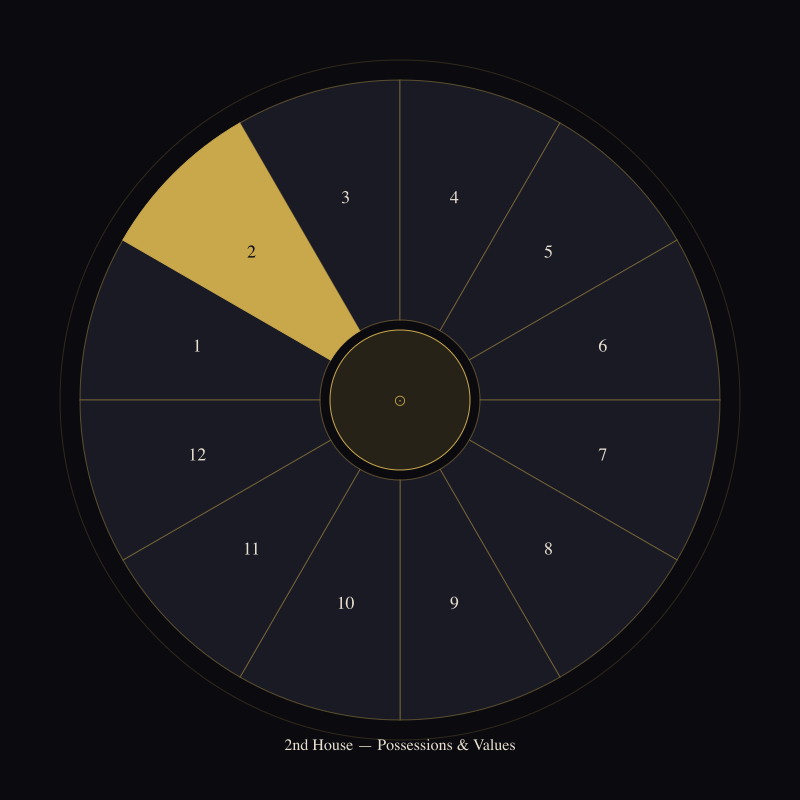

What the 2nd House Governs
The 2nd house rules money, possessions, earned income, and personal values. But reducing it to finances misses the deeper architecture. This is the house of worth — what you value, what you think you deserve, and the tangible resources you accumulate to prove it.
Every financial pattern you have — the compulsive saving, the impulsive spending, the guilt around charging what you are worth — traces back to this house. It is not just about how much you earn. It is about your relationship with having.
The 2nd house also governs the physical senses. Taste, touch, smell — the ways you engage with the material world. People with strong 2nd house placements are often sensual in the literal sense: they need good food, comfortable textures, beautiful objects. Deprivation registers as a threat, not just an inconvenience.
Planets in the 2nd House
Planets placed here shape your financial instincts and your relationship with material security.
- Sun in the 2nd house: Identity is intertwined with what you build, earn, and own. Self-worth is a central life theme, and your sense of purpose often gets expressed through tangible creation and the steady accumulation of value.
- Moon in the 2nd house: Emotional security is tied to material security. Your moods rise and fall with your bank balance, and you often need physical comfort — good food, soft fabrics, a safe home — to feel emotionally settled.
- Mercury in the 2nd house: You think strategically about money and resources. Earning often involves communication, writing, or analysis. You hold strong opinions about value and articulate them clearly — sometimes too clearly.
- Venus in the 2nd house: A natural placement — Venus rules this house in the natural zodiac. You attract resources with relative ease and have refined taste. Money tends to flow toward you, though you spend it on beauty and comfort just as readily.
- Mars in the 2nd house: You earn through action and initiative. Income is tied to effort and competition. You spend impulsively and can be aggressive about protecting what is yours.
- Jupiter in the 2nd house: Generous and often lucky with money, though the luck can breed carelessness. You believe in abundance, and that belief tends to be self-fulfilling — until it meets a reality check.
- Saturn in the 2nd house: Money comes with lessons attached. You may have experienced scarcity early in life, and financial security is something you build slowly, carefully, and with significant anxiety along the way. The payoff is real wealth, earned through discipline.
- Uranus in the 2nd house: Income is unpredictable. You may earn in unconventional ways — freelance, equity, sudden windfalls, or volatile assets. Your relationship with possessions is detached; you can let go of things others hoard.
- Neptune in the 2nd house: Confusion or idealism around money. You may underestimate your worth, give resources away unconsciously, or have a sense that material wealth is somehow spiritually suspect. Financial boundaries blur easily.
- Pluto in the 2nd house: Intense relationship with money and power. Finances may go through dramatic cycles of gain and loss. There is often a fear of financial vulnerability that drives accumulation.
What an Empty 2nd House Means
An empty 2nd house does not mean you will be poor or lack values. It means your relationship with money and self-worth runs through the sign on the cusp and the planet that rules it, rather than through direct planetary emphasis. Most people have empty houses — they describe areas of life that operate quietly in the background.
To read an empty 2nd house, find the sign on the cusp, identify its ruling planet, and check where that planet sits in your chart. If you have Sagittarius on the 2nd cusp and Jupiter in your 9th house, your earnings are colored by 9th house themes — publishing, teaching, foreign work, or law. The house and aspects of the ruler describe your earning landscape.
An empty 2nd house can also signal that financial themes are not where your soul does its heaviest lifting in this life. You may earn and spend without the existential weight that 2nd-house-loaded charts carry. The themes are still active, just less amplified.
2026 Transits Through the 2nd House
2026 brings significant outer planet movement that affects the 2nd house depending on which sign sits on its cusp. Pluto in Aquarius (through 2044) is rebuilding the financial structures of anyone with Aquarius on the 2nd cusp — old money habits dissolve, new ones emerge from crisis and reinvention.
Saturn and Neptune in Aries (Saturn 2025–2028, Neptune 2025–2038) are reshaping the value systems of charts with Aries on the 2nd cusp. Saturn brings discipline and reality to finances; Neptune dissolves old assumptions about what wealth means. The conjunction in early 2026 is particularly potent — a once-in-165-year reset of financial identity.
Uranus in Gemini (entered July 2025) destabilizes the income of Gemini 2nd-cusp charts. New revenue streams, freelance pivots, or unexpected financial volatility define the next seven years. Jupiter in Cancer (June 2025 – June 2026) expands Cancer 2nd cusp earnings, then moves to Leo (June 2026 – July 2027) for a year of generous financial growth in Leo 2nd-cusp charts.
Eclipses in Aries and Libra throughout 2025–2026 mark turning points for charts with these signs on the 2nd or 8th cusps — sudden raises, layoffs, inheritances, or shifts in what you value most.
The 2nd House and Self-Worth
This is the house where self-worth and net worth become entangled — and where they need to be separated. The 2nd house does not just describe your bank balance. It describes how you feel about yourself when you check that balance.
People with challenged 2nd houses often confuse their value as a person with their value on a paycheck. They undercharge, overwork, or accumulate possessions as proof that they matter. The work here is recognizing that your worth exists independent of what you own.
Conversely, a well-supported 2nd house produces people who know what they bring to the table. They set boundaries around their time and skills. They charge what they are worth without apology, not because they are greedy, but because they understand the transaction clearly.
Whatever sign rules your 2nd house describes how you build self-worth. Aries on the 2nd house cusp builds worth through independent action. Libra on the 2nd cusp builds worth through partnership and beauty. The method varies; the need is universal.
The 2nd House Through the Signs
The sign on your 2nd house cusp colors your entire approach to money and value systems.
Earth signs (Taurus, Virgo, Capricorn) on the 2nd house cusp tend to be practical with money — savers, planners, people who feel physically safer when the account is padded. They value tangible results and concrete assets.
Fire signs (Aries, Leo, Sagittarius) here are more willing to spend on experience and impulse. They earn boldly and sometimes recklessly, trusting that more will come. Their relationship with money is energetic rather than cautious.
Air signs (Gemini, Libra, Aquarius) on the 2nd cusp value ideas, connections, and aesthetics as much as cash. They may be intellectually strategic about money but emotionally detached from it. Spending on books, art, and social experiences feels like investment, not indulgence.
Water signs (Cancer, Scorpio, Pisces) here tie money directly to emotional security. Financial stress becomes emotional crisis. They may hoard resources out of deep-seated fear, or give everything away because boundaries around "mine" and "yours" dissolve easily.
Transits and Progressions to the 2nd House
When outer planets transit your 2nd house, your financial landscape shifts — sometimes dramatically. Saturn transiting the 2nd house often brings a period of financial tightening, a forced reckoning with what you can actually afford, and the slow construction of a more sustainable relationship with money.
Uranus through the 2nd house destabilizes your income sources. Freelancers, entrepreneurs, and anyone whose income was already variable will feel this as intensified unpredictability. The purpose is liberation from financial structures that no longer serve you, but the process is uncomfortable.
Jupiter transiting the 2nd house is often experienced as a windfall year — raises, new income streams, or simply a more generous relationship with spending. The risk is overextension: Jupiter expands whatever it touches, including debt.
Pay attention to eclipses in your 2nd house. They mark turning points in your financial story — new jobs, sudden expenses, inheritance, or a fundamental shift in what you consider valuable.
2nd House Through the 6 Systems
How each ancient system sees this archetype
The House of Value. Rules money, possessions, and self-worth. The 2nd house describes your relationship with resources — what you own, what you're worth, and what you refuse to sell.
Dhana Bhava — the house of accumulated wealth, family of origin, and speech. Includes the koshas you inherit: voice, food, early resource memory.
Aligns with the Throat and Spleen themes of material survival. 2nd house activations influence the body's security baseline and the authority that speaks your values.
In the 64 Archetypes framework, the 2nd house carries the vocational hexagram — the material frequency through which the prime creative gift generates sustainable abundance.
The 2nd house corresponds to the first Mercury-period card in your Seven-Year Spread — what you earn, value, and build material security around in the current cycle.
The 2nd house resonates with the number 2 (partnership, value exchange) and with the number 5 (resourcefulness). The arithmetic of worth.
Frequently Asked Questions
- What does the 2nd house represent in astrology?
- The 2nd house governs money, material possessions, earned income, personal values, and self-worth. It describes your relationship with resources and what security means to you on a practical level.
- Is the 2nd house only about money?
- No. While finances are a major theme, the 2nd house also rules your value system, self-worth, physical senses, and the things you consider non-negotiable. Money is one expression of a deeper pattern around what you hold dear.
- What does Saturn in the 2nd house mean?
- Saturn in the 2nd house often indicates a serious, disciplined approach to money — sometimes born from early experiences of scarcity. Financial stability comes through hard work and patience, and the long-term outcome is typically solid, sustainable wealth.
- How do I find my 2nd house sign?
- Your 2nd house sign is determined by your birth time and location. It is the sign that follows your rising sign in the zodiac wheel. An accurate birth chart calculation will show you exactly which sign rules your 2nd house and any planets placed there.
- Whole sign vs Placidus — which house system should I use for the 2nd house?
- Both systems work and astrologers debate this constantly. Whole sign houses (used in traditional and Hellenistic astrology) assign each entire sign to one house — your 2nd house is the entire sign that follows your rising sign. Placidus (the modern default) uses time-based calculations, so houses can be larger or smaller and may include intercepted signs. Whole sign tends to be more stable across latitudes; Placidus offers more nuance through cusps and interceptions. Many modern astrologers use Placidus for natal charts and whole sign for transit work.