What the 7th House Governs
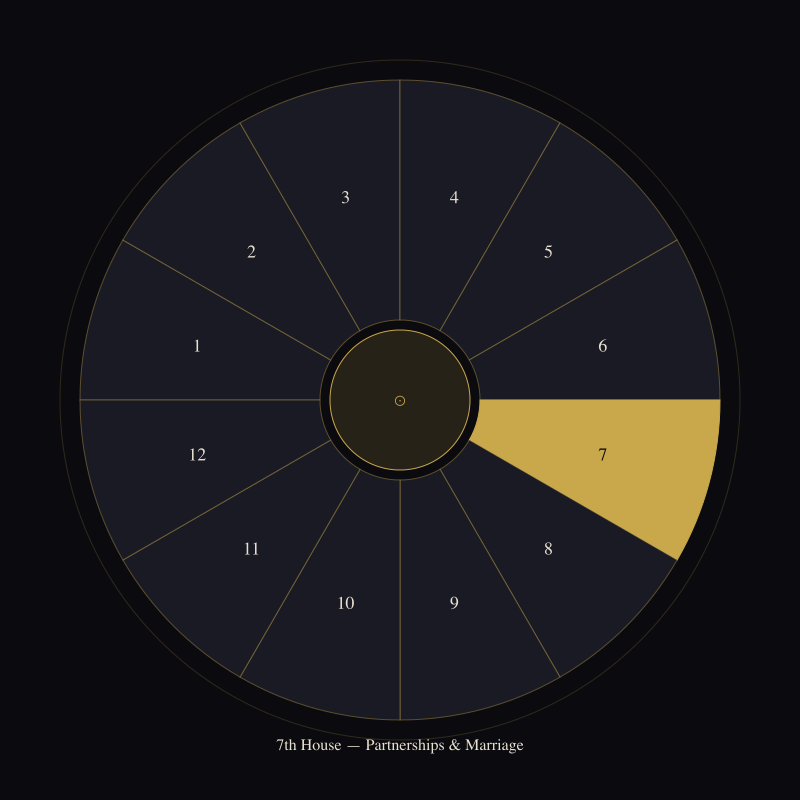
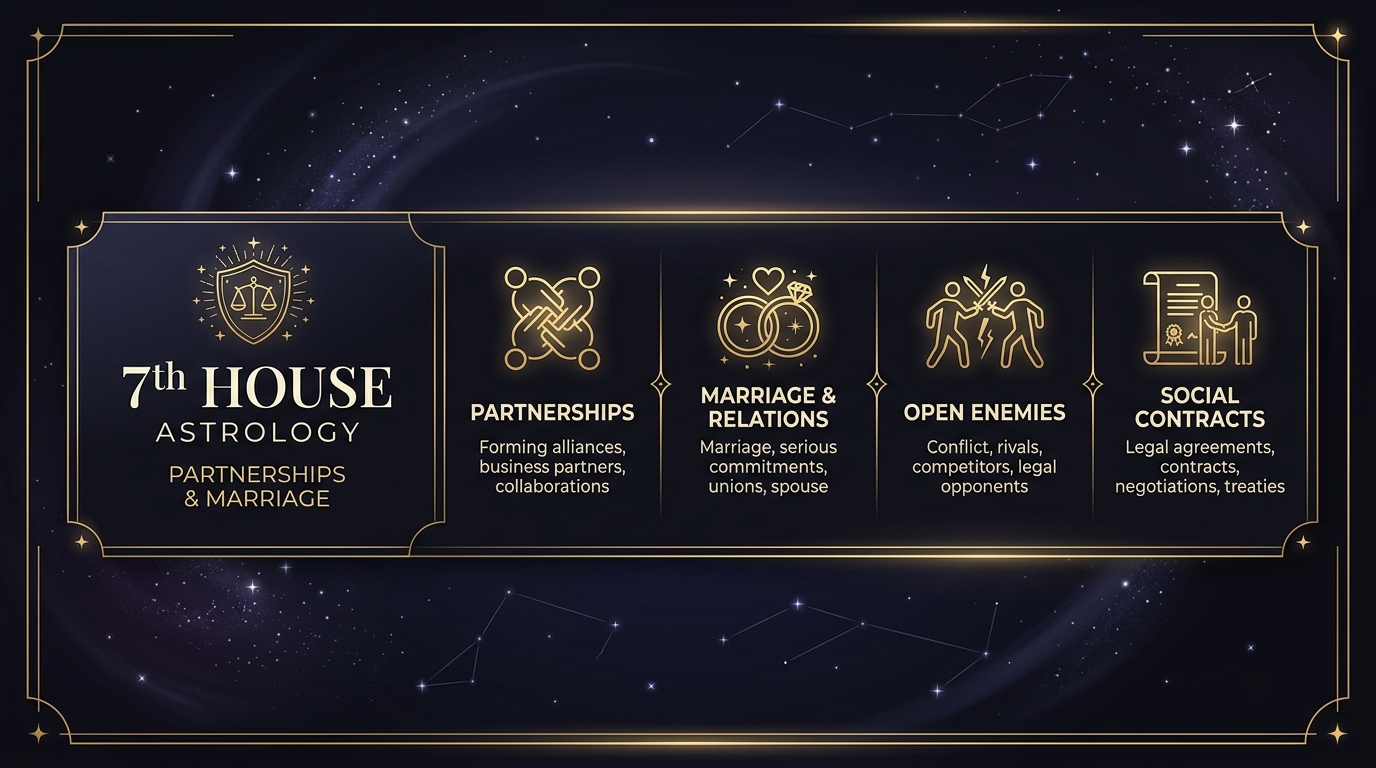
The 7th house rules marriage, committed partnerships, business partners, contracts, open enemies, and one-on-one relationships of all kinds. It sits directly opposite the 1st house, creating the self/other axis that runs through every human life.
Where the 1st house is "I," the 7th house is "you" — the person across the table, the partner in the bed, the opponent in the negotiation. This house describes not just who you choose but why you choose them, and the patterns that repeat across your significant relationships.
The traditional association with "open enemies" makes more sense when you understand the 7th house as the house of direct confrontation. Partnerships and rivalries share a structure: both require two people fully engaged with each other. Your strongest opponents often look remarkably like your partners — and vice versa.
Planets in the 7th House
Planets in the 7th house shape your experience of partnership and the type of people you attract.
- Sun in the 7th house: Identity is forged through partnership. You become more fully yourself in committed relationships, and you may struggle to identify your edges when single. Marriage or business partnership is often a defining life experience.
- Moon in the 7th house: Emotional fulfillment requires partnership. You feel most stable when paired and may experience deep emotional fluctuation in relationship dynamics. You attract nurturing partners or take on the nurturing role yourself.
- Mercury in the 7th house: You think out loud through your partner. Conversation is the lifeblood of your relationships — you need a partner you can talk with for hours. Business partnerships involving communication, writing, or analysis often succeed.
- Venus in the 7th house: Partnership is a priority and comes relatively naturally. You attract harmonious, aesthetically aware people. The risk is prioritizing the relationship's surface beauty over its structural integrity.
- Mars in the 7th house: You attract assertive, sometimes combative partners. Conflict is a feature of your relationships, not a bug — you need friction and directness. Passive partners bore you; challenging ones keep you sharp.
- Jupiter in the 7th house: Lucky in partnership. You attract generous, expansive partners — sometimes from foreign backgrounds or with broader-than-average worldviews. Marriage often brings tangible benefit. The risk is overcommitting too quickly in Jupiter's optimism.
- Saturn in the 7th house: Partnerships carry weight. You may marry later, choose older or more serious partners, and experience relationships as testing grounds for maturity. Commitment means something real to you — which is why you do not offer it lightly.
- Uranus in the 7th house: Partnerships are unconventional, sudden, or unstable. You may marry someone unusual, divorce abruptly, or maintain unconventional relationship structures. Freedom is non-negotiable — partners who try to contain you do not last.
- Neptune in the 7th house: You idealize partners, sometimes seeing who they could be rather than who they are. Boundaries in relationships are porous. At best, partnerships are deeply compassionate; at worst, they involve deception or dissolution of self.
- Pluto in the 7th house: Partnerships are transformative and intense. You attract powerful people and relationships that change you at a fundamental level. Power dynamics and control issues are themes that must be consciously addressed.
What an Empty 7th House Means
An empty 7th house — frequently asked about on Reddit relationship threads — does not mean you will never marry or have meaningful partnerships. It means the 7th house operates through the sign on the Descendant and the planet that rules it, rather than through direct planetary occupation. Most charts have empty houses.
To read an empty 7th house, find the sign on your Descendant (the cusp of the 7th) and locate its ruling planet. If you have Sagittarius on the Descendant and Jupiter in your 3rd house, your partnerships are colored by 3rd-house themes — you may marry a sibling figure, meet your partner through a course or local community, or partner well with someone whose communication style matches yours.
An empty 7th house can produce people whose marriage or partnership is significant but not the central life lesson. You may form lasting relationships without the heavy projection-and-integration work of someone with multiple planets in the 7th. The themes are still active — just less amplified.
2026 Transits Through the 7th House
2026 brings significant transits to 7th-house themes. Saturn and Neptune in Aries activate Aries 7th-cusp charts (those with Libra rising) — Saturn forces a reckoning with partnership commitments (long-term relationships either solidify or end), while Neptune dissolves illusions about who your partner really is. The conjunction in early 2026 marks a milestone in many marriages.
Pluto in Aquarius (through 2044) transforms Aquarius 7th-cusp partnerships at the deepest level — power dynamics surface for healing, and relationships that cannot tolerate equality dissolve. Uranus in Gemini (entered July 2025) brings sudden partnership changes for Gemini 7th-cusp charts: unexpected marriages, divorces, or radical shifts in the kind of partner who attracts you.
Jupiter in Cancer (through June 2026) is a beautiful transit for Cancer 7th-cusp charts — partnership flourishes, marriages deepen, business partners bring abundance. Jupiter in Leo (June 2026 onward) brings expansion and visibility to Leo 7th-cusp partnerships throughout the year.
Eclipses in Aries and Libra throughout 2025–2026 mark turning points in partnerships for charts with these signs on the 7th-1st axis — engagements, divorces, business partnerships forming or dissolving, and confrontations with adversaries.
The 7th House as a Mirror
The 7th house is always opposite your rising sign, which means it describes qualities you instinctively project outward. If you have Aries rising, your 7th house is in Libra — and you may attract diplomatic, partnership-oriented people while denying your own need for harmony. If you have Cancer rising, your 7th house is in Capricorn — and you may attract ambitious, structured partners while undervaluing your own authority.
This projection is not a flaw. It is how the 7th house teaches. You learn about the undeveloped parts of yourself by meeting them in another person. The partner who drives you crazy is often embodying something your chart says you need to integrate.
Over time, the work of the 7th house is to stop outsourcing those qualities and start owning them yourself. This does not mean you no longer need partners. It means you stop needing them to be the things you refuse to be. Relationships become more balanced when both people carry their own chart instead of splitting it between them.
The 7th House Through the Signs
The sign on your 7th house cusp (the Descendant) describes what you seek in partnership and often what you attract without trying.
Fire signs on the Descendant (Aries, Leo, Sagittarius) attract bold, energetic, sometimes dominating partners. You are drawn to people who take initiative and carry a spark — even when that spark occasionally burns you.
Earth signs here (Taurus, Virgo, Capricorn) attract stable, reliable partners. You value competence and groundedness in others, and your relationships tend to be built on practical foundations rather than romantic fantasy.
Air signs on the Descendant (Gemini, Libra, Aquarius) attract intellectually stimulating partners. Conversation is the glue of your relationships. You need a partner who can keep up mentally and who treats the relationship as a collaboration between equals.
Water signs here (Cancer, Scorpio, Pisces) attract emotionally deep, intuitive partners. Your relationships involve significant emotional processing and often operate on levels that are difficult to articulate. You do not do surface-level partnership.
Navigating Partnerships With Your 7th House
Understanding your 7th house does not tell you who to marry. It tells you what you are really looking for — and what you are really avoiding. The patterns in your relationship history are not accidental. They are 7th house patterns, repeating until you recognize them.
Transits to the 7th house bring partnership events: engagements, divorces, business partnerships forming or dissolving, and confrontations with rivals. Saturn transiting the 7th is famous for either solidifying a commitment or ending a relationship that cannot bear the weight of reality.
Jupiter through the 7th house often brings a significant new relationship or an expansion of existing partnerships. The caution is that Jupiter can also bring too much — partners who are overconfident, or a tendency to commit too quickly in the warmth of Jupiter's optimism.
The 7th house ultimately teaches that relationships are not escapes from the self but reflections of it. What you find in a partner is what you were carrying all along. The chart just makes it visible.
7th House Through the 6 Systems
How each ancient system sees this archetype
The House of Partnership. Rules marriage, business partners, open enemies, and the people the self attracts as mirrors. The 7th house is the Descendant — the you-that-is-not-you.
Kalatra Bhava — the house of spouse, contracts, and public reputation. The 7th lord's condition is the primary indicator of marital destiny in Vedic compatibility analysis.
Aligns with the G-Center and Solar Plexus themes of bonding. 7th house activations shape the aura's partnership templates — who you attract, marry, and negotiate with.
In the 64 Archetypes framework, the 7th house carries the hexagram of primary partnership — the mirror-relationship where the shadow is most clearly seen and integrated.
The 7th house aligns with the marriage archetype in the card system — the karmic partner whose card interlocks with yours, and the templates of long-term commitment.
The 7th house resonates with the number 7 (depth, inner knowing) and the number 2 (partnership). The arithmetic of sacred relationship.
Frequently Asked Questions
- What does the 7th house represent in astrology?
- The 7th house governs committed partnerships, marriage, business relationships, contracts, and open enemies. It describes who you attract, what you need from a partner, and the qualities you tend to project onto others.
- Is the 7th house only about romantic relationships?
- No. The 7th house covers all significant one-on-one relationships, including business partnerships, legal adversaries, and close collaborators. Any relationship that involves a formal or deeply committed dynamic falls under this house.
- What does Descendant mean in astrology?
- The Descendant is the cusp of the 7th house — the point directly opposite your Ascendant (rising sign). It describes the qualities you seek in partners and the type of person you naturally attract into committed relationships.
- Why do I keep attracting the same type of partner?
- Your 7th house sign and any planets there describe a consistent pattern in what you seek and attract. These are not random — they reflect the qualities your chart asks you to engage with through partnership. Understanding this pattern is the first step toward choosing more consciously.
- What does it mean to have the Sun in the 7th house?
- Sun in the 7th house means your sense of identity is forged through committed partnership. You become more fully yourself in relationship and may struggle to identify your edges when single. Marriage or business partnership is often a defining life experience, and you may feel a strong pull toward "the other" — sometimes to the point of needing to consciously develop your own independent self alongside the partner.