
The Generational Signature: 1984–1998
Neptune entered Capricorn in 1984—the year Orwell chose for his surveillance dystopia—and immediately began dissolving the structures that the Cold War had held rigid for decades. The Soviet Union, which had seemed as permanent as granite, disintegrated within five years of the ingress. The Berlin Wall fell in 1989. Apartheid ended. These were not gradual reforms; they were Neptunian dissolutions—structures that looked solid turning out to be fog.
Corporate authority suffered the same fate. The generation born during this transit watched Enron, WorldCom, and Arthur Andersen collapse—not from external attack, but from internal rot masked by institutional prestige. The 2008 financial crisis, which hit just as the oldest Neptune-in-Capricorn natives were entering the workforce, completed the lesson: the systems your parents trusted to provide stability were built on foundations no more solid than the mortgages that backed them.
The positive expression of this transit is a clear-eyed understanding that institutions are human creations, not natural laws. This generation does not reject structure; it demands that structure be transparent, accountable, and honest about its limitations. The shadow side is a corrosive cynicism about all authority—the assumption that every institution is corrupt, every leader is compromised, and nothing built by humans can be trusted to stand.
Neptune in Capricorn in Your Birth Chart
If Neptune in Capricorn sits in your natal chart, the house it occupies shows where your relationship with authority and structure is most complex. In the 10th house (Capricorn’s natural domain), your career path may involve dissolving outdated institutional structures or working within systems that are in the process of transformation—healthcare, government, education during a period of upheaval. In the 4th house, your family’s authority structure may have been unstable; perhaps a parent who represented order was absent or unreliable.
Aspects to Saturn (Capricorn’s ruler) define the tension. Neptune conjunct Saturn produces a personality caught between idealism and pragmatism—you see the vision (Neptune) and you see the obstacles (Saturn), and the challenge is holding both without either paralyzing you or making you cynical. A square from Neptune to Saturn can manifest as chronic self-doubt about your competence, or as difficulty trusting your own authority even when you have earned it.
The house makes the generational signature personal. Neptune in Capricorn in the 6th house dissolves certainty about work routines—you may thrive in careers where the job description keeps shifting, or struggle in rigid corporate environments that demand conformity. In the 11th house, your idealism about community and social progress runs up against a hard awareness of how institutions actually function. Your chart shows where structure dissolves and where you must build something more honest in its place.
Historical Cycles and Institutional Reckoning
The previous Neptune-in-Capricorn transit (roughly 1820–1834) coincided with the dissolution of the Spanish Empire in the Americas. Colony after colony declared independence as the imperial structure that had governed for three centuries dissolved from within. Simón Bolívar’s campaigns were not just military victories; they were the visible collapse of an authority structure that Neptune had already hollowed out from the inside.
Further back, the transit around 1657–1671 overlapped with the Restoration in England—the attempt to rebuild monarchical authority after the Civil War had proven that kings could be deposed and executed. The restored monarchy was never the same institution; it carried Neptune’s mark, a permanent awareness of its own fragility. Constitutional monarchy—limited, accountable, transparent about its ceremonial nature—was Neptune in Capricorn’s lasting gift to British governance.
The 1984–1998 generation is now entering positions of institutional power. Whether they rebuild the structures they watched dissolve—or create entirely new ones—will define the next several decades. Your chart shows which house holds this placement and where your personal relationship with authority, ambition, and institutional trust carries its most urgent questions.
Your Neptune in Capricorn
A 2-3 sentence reading drawn from your actual chart data, generated once and saved to your profile.
Neptune Through the 6 Systems
How each ancient system sees this archetype
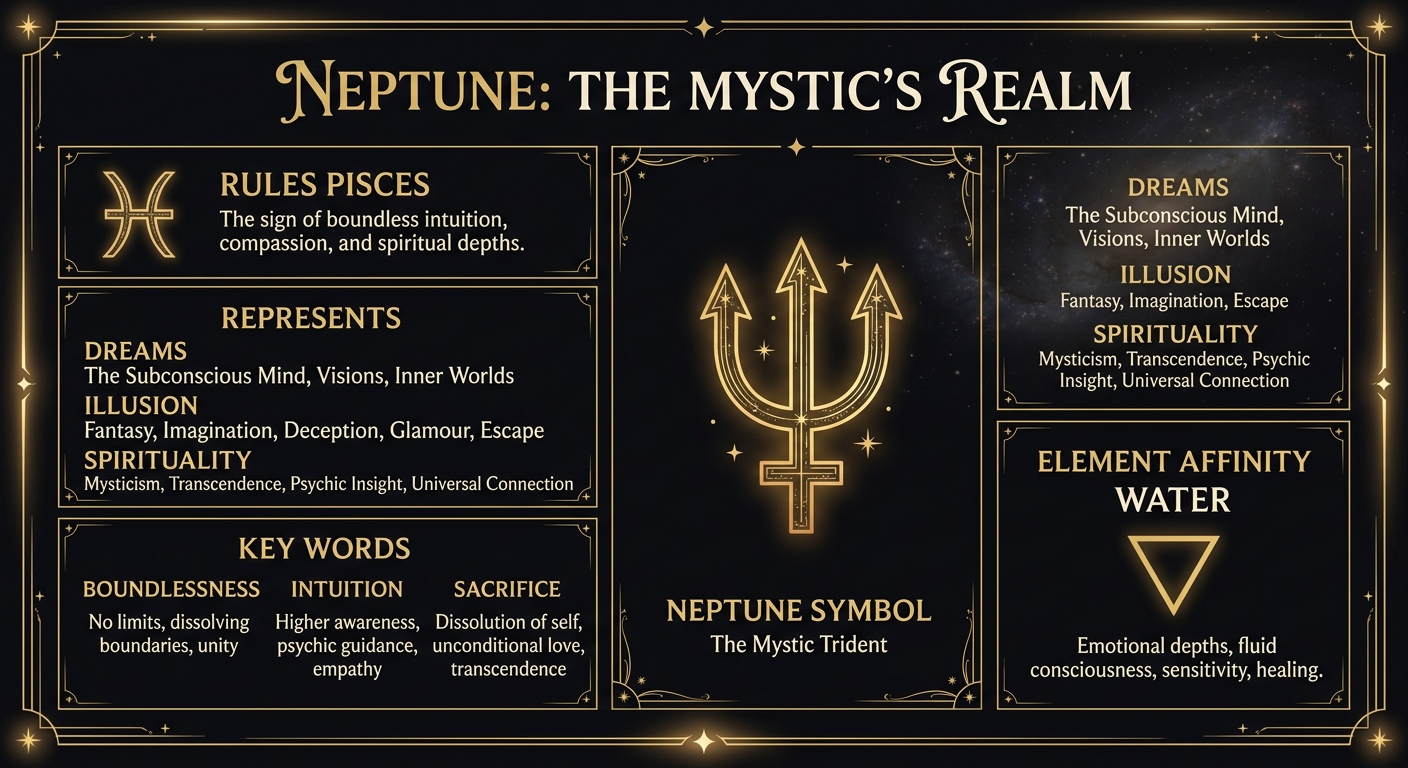
Dissolution, imagination, and the transpersonal. Neptune is the solvent — the principle that thins the boundary between self and source, and opens the artist's and mystic's channels.
Traditional Jyotish attributes Neptune's themes to Ketu (the South Node) — the dissolving graha of moksha, spiritual surrender, and the falling-away of worldly identity.
Neptune moves slowly through the bodygraph; its generational transits carry the collective fog-and-awakening themes that each cohort must see through for real clarity.
In the 64 Archetypes framework, Neptune's generational hexagram carries the dissolving current — the subtle-body layer where individual pattern meets the transpersonal field.
Neptune in Cardology shows up in the deep cycle spreads — the slow tides that shape a generation's romantic ideals, spiritual longings, and creative myths.
Neptune resonates with Master Number 22 (the Master Builder of the unseen) and with Life Path 7 at its most mystical. The principle of transcendent imagination.
Frequently Asked Questions
- What does Neptune's sign reveal in a birth chart?
- Neptune's sign describes the collective ideals, illusions, and spiritual currents of your generation. In your personal chart, Neptune's house and aspects to personal planets reveal where you are most susceptible to dissolving boundaries — and where your intuition and imagination are deepest.
- How does Neptune sign affect intuition and imagination?
- Neptune dissolves the sharp edges of whatever it touches, opening space for imagination, empathy, and spiritual perception. Its sign describes the domain where your generation sought transcendence — and where you personally are most capable of profound sensitivity and most vulnerable to self-deception.
- How long does Neptune stay in each sign?
- Neptune spends approximately fourteen years in each zodiac sign, taking roughly 165 years to complete a full cycle. No living person experiences a Neptune return, which is why it operates almost entirely as a generational signature — made personal only through house placement and aspects.
- Does Neptune sign affect spiritual development?
- Neptune's sign describes the style and framework through which your generation pursues spiritual experience. Whether that takes the form of religious devotion, artistic transcendence, psychedelic exploration, or collective compassion depends on the sign — and on the rest of your chart.