The Generational Signature: 1914–1939
Pluto entered Cancer in 1914—the year World War I began. This was not coincidence. Pluto in Cancer destroys the homeland to remake it, and the Great War destroyed homelands across Europe with unprecedented thoroughness. Millions of families were shattered. Entire nations were erased from the map and redrawn. The Ottoman, Austro-Hungarian, German, and Russian empires—each representing a particular vision of homeland and belonging—all collapsed within this transit’s first decade.
The Great Depression (1929–1939) attacked the other dimension of Cancer’s domain: material security. The ability to feed your family—the most fundamental Cancerian need—was stripped from millions. Dust Bowl migrations uprooted entire communities. The generation born during this transit internalized a relationship with security that never fully relaxed: always save, always prepare, always remember that the floor can give way without warning.
The rise of fascism and nationalism represented the shadow expression of Pluto in Cancer: the weaponization of homeland mythology. “Blood and soil” was a Pluto-in-Cancer slogan—the fusion of family lineage with territorial power, taken to its most destructive extreme. Understanding this transit means understanding how the deepest human need—to belong, to be safe, to be home—can be corrupted into the deepest human cruelty.
Pluto in Cancer in Your Birth Chart
If you carry natal Pluto in Cancer (born roughly 1914–1939), your relationship with family and security has a volcanic quality that younger generations rarely understand. You know, at a cellular level, that safety is not guaranteed. That knowledge is not anxiety—it is wisdom, hard-won and non-negotiable.
The house placement shows where family power dynamics play out most intensely. In the 4th house (Cancer’s natural domain), the family home was the site of transformation—possibly traumatic, possibly profoundly regenerative, often both. In the 10th house, your public life was shaped by family expectations that carried the weight of survival rather than mere ambition.
Moon aspects to Pluto in Cancer define the emotional texture of the placement. A conjunction produces emotional intensity that can be overwhelming—you feel everything at full depth, and you expect others to do the same. A square creates power struggles around nurturing: who takes care of whom, who gets to be vulnerable, who carries the family’s emotional weight. These patterns often repeat across generations until someone makes them conscious.
Historical Cycles and What Comes Next
The prior Pluto-in-Cancer transit (1669–1693) saw the consolidation of European colonial empires—the transformation of “homeland” from a local concept to a global one, as nations claimed territories on distant continents and called them extensions of home. The Salem witch trials (1692) represented the shadow: community paranoia turned inward, destroying families in the name of protecting them.
Each Pluto-in-Cancer cycle forces a reckoning with what family, home, and nation actually mean—and what people are willing to do in their name. The answers vary, but the intensity never does. Pluto in Cancer is where love and power meet at their most primal, and the transformation it produces reshapes everything built on the foundation of belonging.
The next Pluto-in-Cancer transit arrives approximately 2157–2183. Your chart, regardless of when you were born, shows where Cancer falls—and that is where the deepest questions about family, home, and emotional power carry Plutonian intensity whenever activated by transit or progression.
Your Pluto in Cancer
A 2-3 sentence reading drawn from your actual chart data, generated once and saved to your profile.
Pluto Through the 6 Systems
How each ancient system sees this archetype
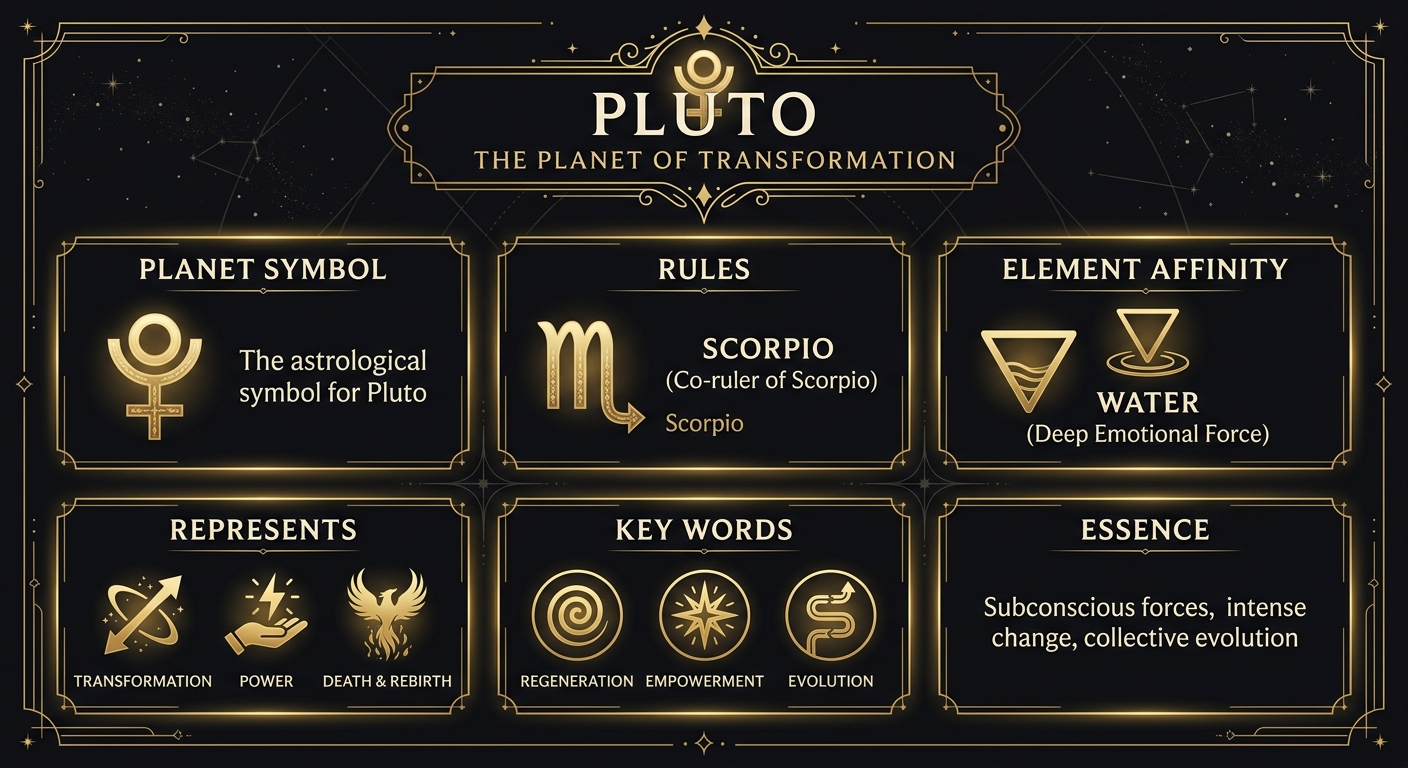
Transformation, power, and the underworld. Pluto is the generational pressure that destroys what cannot evolve — and returns what remains to a deeper, truer form.
Traditional Jyotish attributes Pluto's themes to Mangala (Mars) in its most tamasic form, and to the Rahu-Ketu axis — the karmic compulsion to transform through depth encounters.
Pluto's 12-to-30-year transits through each sign define the deepest generational conditioning. Pluto in the bodygraph marks the collective shadow themes your cohort came to transmute.
In the 64 Archetypes framework, Pluto's generational hexagram holds the deepest ancestral pattern — the transpersonal wound that eventually transfigures into collective gift.
Pluto's long transits mark the death-rebirth cycles in the lifetime spread — the moments when a card position empties out so a new configuration can emerge.
Pluto resonates with Master Number 33 (sacrificial transformation) and with the number 8 at its most alchemical. The principle of death and resurrection.
Frequently Asked Questions
- What does Pluto's sign reveal in a birth chart?
- Pluto's sign describes the generational arena of deep transformation, power struggle, and irreversible change. In your personal chart, Pluto's house and aspects reveal where that collective pressure for transformation is most personally felt — where you encounter intensity, compulsion, and the need to shed what no longer serves.
- How does Pluto sign affect transformation and power?
- Pluto's sign shows the domain where your generation dismantles and rebuilds. In personal placements, it reveals where you are capable of profound depth and regeneration — and where you are most likely to encounter control, obsession, or the kind of loss that fundamentally changes who you are.
- How long does Pluto stay in each sign?
- Pluto spends between twelve and thirty years in each zodiac sign due to its elliptical orbit, taking approximately 248 years to complete a full cycle. It is the slowest-moving planet and functions almost entirely as a generational force — except where it aspects your personal planets directly.
- What does a Pluto transit to a personal planet mean?
- When Pluto transits your natal Sun, Moon, Venus, Mars, or Mercury, it puts that part of your chart through a process of deep excavation. What felt fixed becomes subject to transformation. These transits are slow, intense, and usually irreversible in their effects — but what survives them tends to be more real than what preceded them.