
The Generational Signature: Historical Cycles
Pluto was last in Pisces from 1797 to 1823. The Romantic movement was born during this transit: Wordsworth, Coleridge, Beethoven, and Goya reached into the depths of human feeling and pulled out art that was not merely beautiful but transformative—art that changed how the audience experienced being alive. Pluto in Pisces does not just produce art; it produces art that acts as a spiritual technology, dissolving the boundary between the observer and the observed.
The transatlantic slave trade was abolished by Britain in 1807 during this transit—a moral transformation driven by empathy (Pisces) and the willingness to destroy an economic system (Pluto) that depended on treating human beings as cargo. The abolitionist movement was Pluto in Pisces at its most powerful: compassion becoming so intense that it demanded the destruction of a centuries-old institution.
Napoleon’s empire rose and fell during this transit. His ambition to reshape Europe was Plutonian; its dissolution was Piscean—overextended, drowned in the Russian winter, undone by the same grandiosity that built it. Pluto in Pisces warns that the deepest power is also the most susceptible to self-destruction through loss of boundaries.
Pluto in Pisces in Your Birth Chart
No one currently alive has natal Pluto in Pisces (the last transit ended in 1823). The placement’s signature in historical charts reveals an extraordinarily deep relationship with the unconscious, the spiritual, and the transcendent. These were people for whom the invisible world was not a metaphor but a lived reality—and who wielded that awareness with transformative power.
In historical charts, the house placement shows where spiritual depth and unconscious power concentrated. In the 12th house (Pisces’s natural domain), the interior life was vast, sometimes overwhelming, and carried the weight of collective suffering and collective transcendence. In the 4th house, the family lineage contained spiritual gifts and spiritual wounds that passed through generations like an underground river.
Neptune rules Pisces, so Neptune aspects to Pluto in Pisces defined the relationship between transcendence and transformation. A sextile or trine allowed the spiritual and the transformative to collaborate—producing healers, mystics, and artists of extraordinary depth. A square created the risk of spiritual inflation: the belief that one’s personal connection to the divine placed one above ordinary human accountability.
What Pluto in Pisces Means for Your Chart Today
The next Pluto-in-Pisces transit (approximately 2043–2068) will arrive within the lifetime of many people reading this. That transit will transform humanity’s relationship with consciousness itself—possibly through psychedelic medicine, AI-assisted meditation, neurotechnology, or practices we have not yet imagined. The generation born during that window will treat the boundary between individual consciousness and collective awareness as negotiable.
Even now, the house where Pisces falls in your chart shows where Pluto-in-Pisces themes resonate: spiritual transformation, the dissolution of ego, the encounter with something vast and impersonal that is also profoundly intimate. When major transits activate that house, you get a preview of what Pluto in Pisces will eventually bring to the collective.
If you have natal planets in Pisces, Pluto’s eventual transit through that sign will activate them with the full force of the slowest, deepest, most relentless planet in the solar system. The transformation will not be quick. It will not be gentle. But it will be thorough—and what survives it will be more real, more whole, and more fully alive than anything that came before.
Your Pluto in Pisces
A 2-3 sentence reading drawn from your actual chart data, generated once and saved to your profile.
Pluto Through the 6 Systems
How each ancient system sees this archetype
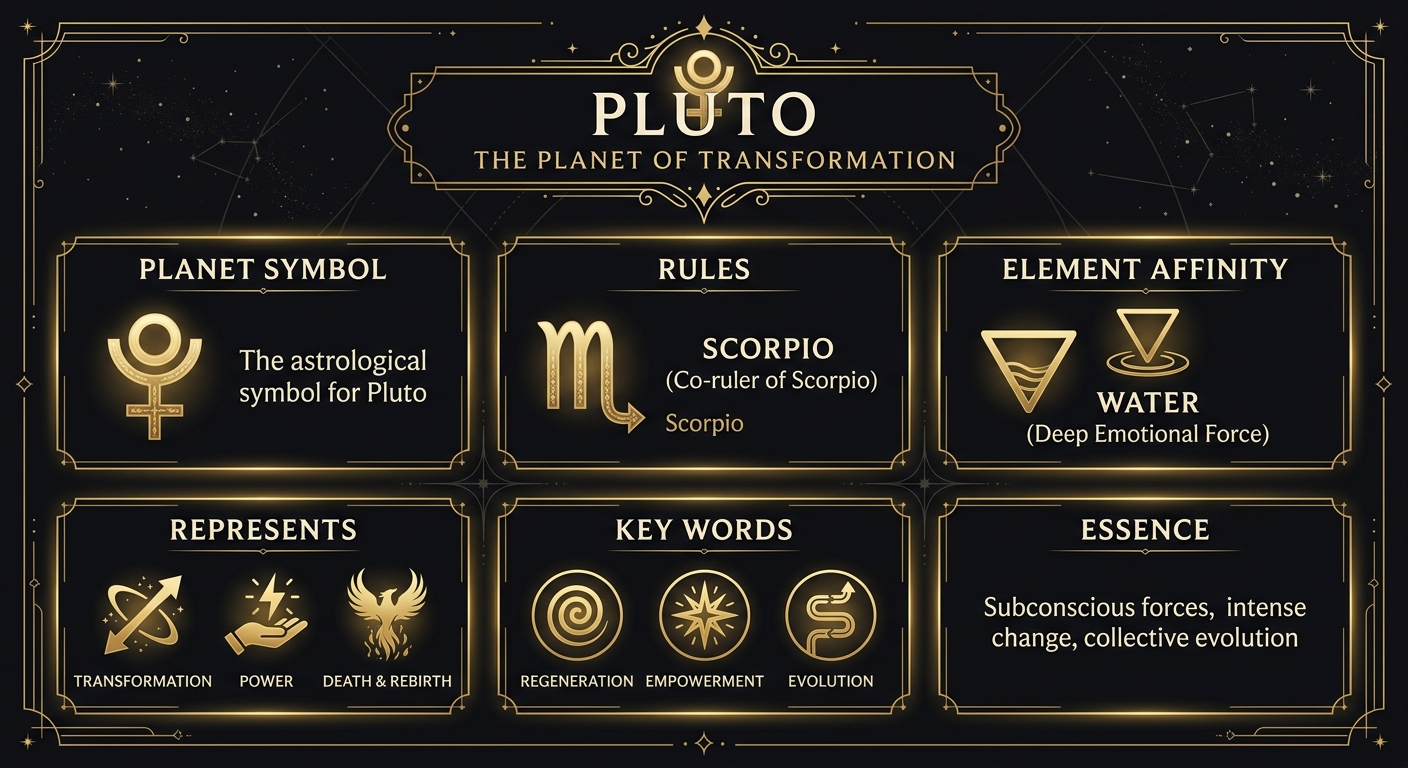
Transformation, power, and the underworld. Pluto is the generational pressure that destroys what cannot evolve — and returns what remains to a deeper, truer form.
Traditional Jyotish attributes Pluto's themes to Mangala (Mars) in its most tamasic form, and to the Rahu-Ketu axis — the karmic compulsion to transform through depth encounters.
Pluto's 12-to-30-year transits through each sign define the deepest generational conditioning. Pluto in the bodygraph marks the collective shadow themes your cohort came to transmute.
In the 64 Archetypes framework, Pluto's generational hexagram holds the deepest ancestral pattern — the transpersonal wound that eventually transfigures into collective gift.
Pluto's long transits mark the death-rebirth cycles in the lifetime spread — the moments when a card position empties out so a new configuration can emerge.
Pluto resonates with Master Number 33 (sacrificial transformation) and with the number 8 at its most alchemical. The principle of death and resurrection.
Frequently Asked Questions
- What does Pluto's sign reveal in a birth chart?
- Pluto's sign describes the generational arena of deep transformation, power struggle, and irreversible change. In your personal chart, Pluto's house and aspects reveal where that collective pressure for transformation is most personally felt — where you encounter intensity, compulsion, and the need to shed what no longer serves.
- How does Pluto sign affect transformation and power?
- Pluto's sign shows the domain where your generation dismantles and rebuilds. In personal placements, it reveals where you are capable of profound depth and regeneration — and where you are most likely to encounter control, obsession, or the kind of loss that fundamentally changes who you are.
- How long does Pluto stay in each sign?
- Pluto spends between twelve and thirty years in each zodiac sign due to its elliptical orbit, taking approximately 248 years to complete a full cycle. It is the slowest-moving planet and functions almost entirely as a generational force — except where it aspects your personal planets directly.
- What does a Pluto transit to a personal planet mean?
- When Pluto transits your natal Sun, Moon, Venus, Mars, or Mercury, it puts that part of your chart through a process of deep excavation. What felt fixed becomes subject to transformation. These transits are slow, intense, and usually irreversible in their effects — but what survives them tends to be more real than what preceded them.