The Generational Signature: 1955–1962
Uranus entered Leo in 1955—the same year Elvis Presley broke through, Rosa Parks refused to move, and Allen Ginsberg read Howl for the first time. The transit lasted through 1962, seeding a generation that would drive the cultural revolutions of the 1960s and 1970s. These were the people who turned 18 during the Summer of Love, who built punk rock, who insisted that personal identity was not inherited but invented.
Leo rules creativity, children, romance, and the performance of self. Uranus in Leo did not just produce new art forms—it produced an entirely new relationship with the concept of artistic expression. Andy Warhol (himself born with strong Leo placements) turned commercial imagery into fine art and celebrity into its own medium. The Beatles went from pop band to cultural force. Self-expression became the primary value of an entire demographic.
The shadow side was narcissism dressed as liberation. Not every act of self-expression carries meaning, and the line between authentic creativity and performative rebellion blurred often. The generation born under this transit spent decades sorting genuine creative fire from ego inflation—a tension that shaped everything from glam rock to reality television.
Uranus in Leo in Your Birth Chart
If Uranus in Leo is in your natal chart, you carry an instinct for creative disruption. The house it occupies tells you where that creative voltage runs hottest. In the 5th house (Leo’s natural domain), your relationship with art, romance, and children is anything but conventional—you love dramatically and create compulsively. In the 11th house, you reshape communities and social groups through sheer force of personality and vision.
Sun aspects to natal Uranus in Leo define the relationship between your core identity and your revolutionary impulse. A conjunction marks you as someone who cannot separate who you are from what you disrupt—your identity is your rebellion. A trine lets the creative and the revolutionary collaborate smoothly; ideas arrive fully formed and ready to perform.
Venus contacts add a layer of aesthetic radicalism. You are drawn to beauty that challenges, that provokes, that refuses to be merely pretty. Your creative and romantic life operates by rules you write yourself—and if someone tries to impose a template, you will burn it with theatrical flair.
Historical Cycles and What Comes Next
The prior Uranus-in-Leo transit (1871–1878) coincided with the Impressionist revolution in painting—Monet, Renoir, and Degas broke every rule of academic art and redefined what a painting could be. Mark Twain published The Adventures of Tom Sawyer, inventing a new American voice in literature. The phonograph was invented in 1877, making it possible for the first time to record and replay creative expression.
Both cycles share the same signature: a fundamental break in how humans create and perform identity. The medium changes—oil paint, electric guitar, digital video—but the impulse is identical: refuse the inherited form, invent a new one, perform it loudly.
The next Uranus-in-Leo transit arrives around 2039–2046. That generation will likely take AI-generated art, immersive media, and identity fluidity to places the current generation cannot fully imagine. If you carry Uranus in Leo in your chart, you already know the impulse: make something that has never existed before, and do not ask for permission first.
Your Uranus in Leo
A 2-3 sentence reading drawn from your actual chart data, generated once and saved to your profile.
Uranus Through the 6 Systems
How each ancient system sees this archetype
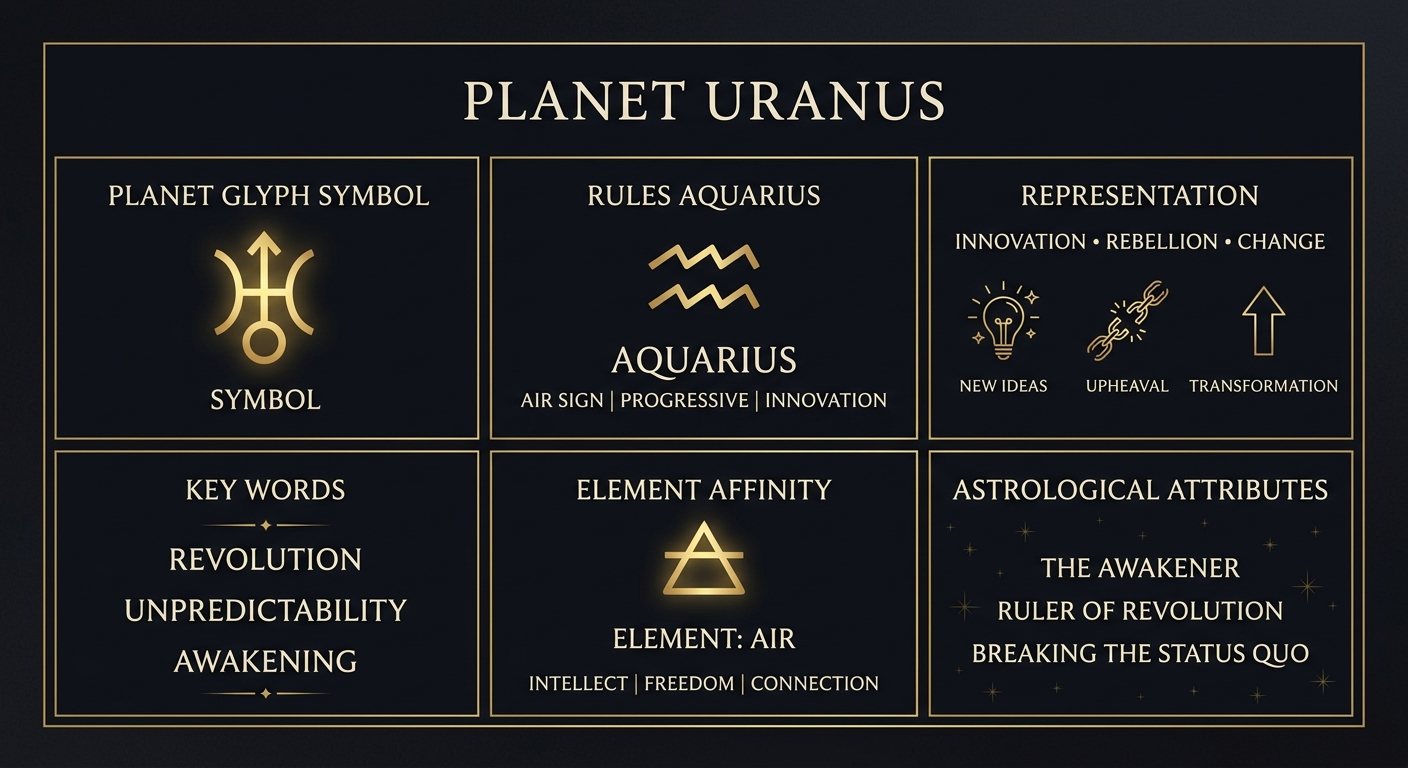
Disruption, individuation, and awakening. Uranus is the lightning strike — the shock that liberates you from who you were told to be and returns you to your authentic frequency.
Traditional Jyotish does not use Uranus; its themes are carried by Rahu (the North Node) — the shadow graha of obsessive innovation, foreign influence, and paradigm rupture.
Uranus carries a 7-year cycle in Human Design — its transits through a sign mark generational awakening themes and the collective individuation pulse of each cohort.
In the 64 Archetypes framework, Uranus' generational hexagram carries the awakening current — the somatic threshold at which the authentic self breaks through inherited conditioning.
Uranus appears in the long-cycle movement rather than the weekly card rotation — its passage through a sign marks the 7-year inflection points when the life's spread visibly rearranges.
Uranus resonates with Master Number 11 (sudden illumination) and with the number 4 inverted — structure collapsing to reveal the genius beneath convention.
Frequently Asked Questions
- What does Uranus's sign reveal in a birth chart?
- Uranus's sign describes the generational frequency of disruption and innovation you were born into. Natally, its house position and aspects to personal planets reveal where that collective urge for freedom and radical change manifests most personally in your life.
- How does Uranus sign affect innovation and rebellion?
- Uranus's sign colors the style and domain of the generation's urge to break with the past. In your personal chart, Uranus aspects show where you carry that impulse most acutely — where you resist convention, crave originality, and are prone to sudden, irreversible change.
- How long does Uranus stay in each sign?
- Uranus spends approximately seven years in each zodiac sign, taking 84 years to complete a full cycle. Because of this, it functions primarily as a generational planet — but its house placement and aspects to personal planets make it deeply individual in your chart.
- What does a Uranus return mean?
- A Uranus return — when Uranus completes its 84-year cycle and returns to its natal position — is rarely lived in full. The Uranus half-return at around age 42 is more commonly experienced: a jolt of mid-life disruption where the unlived parts of your chart demand expression.